
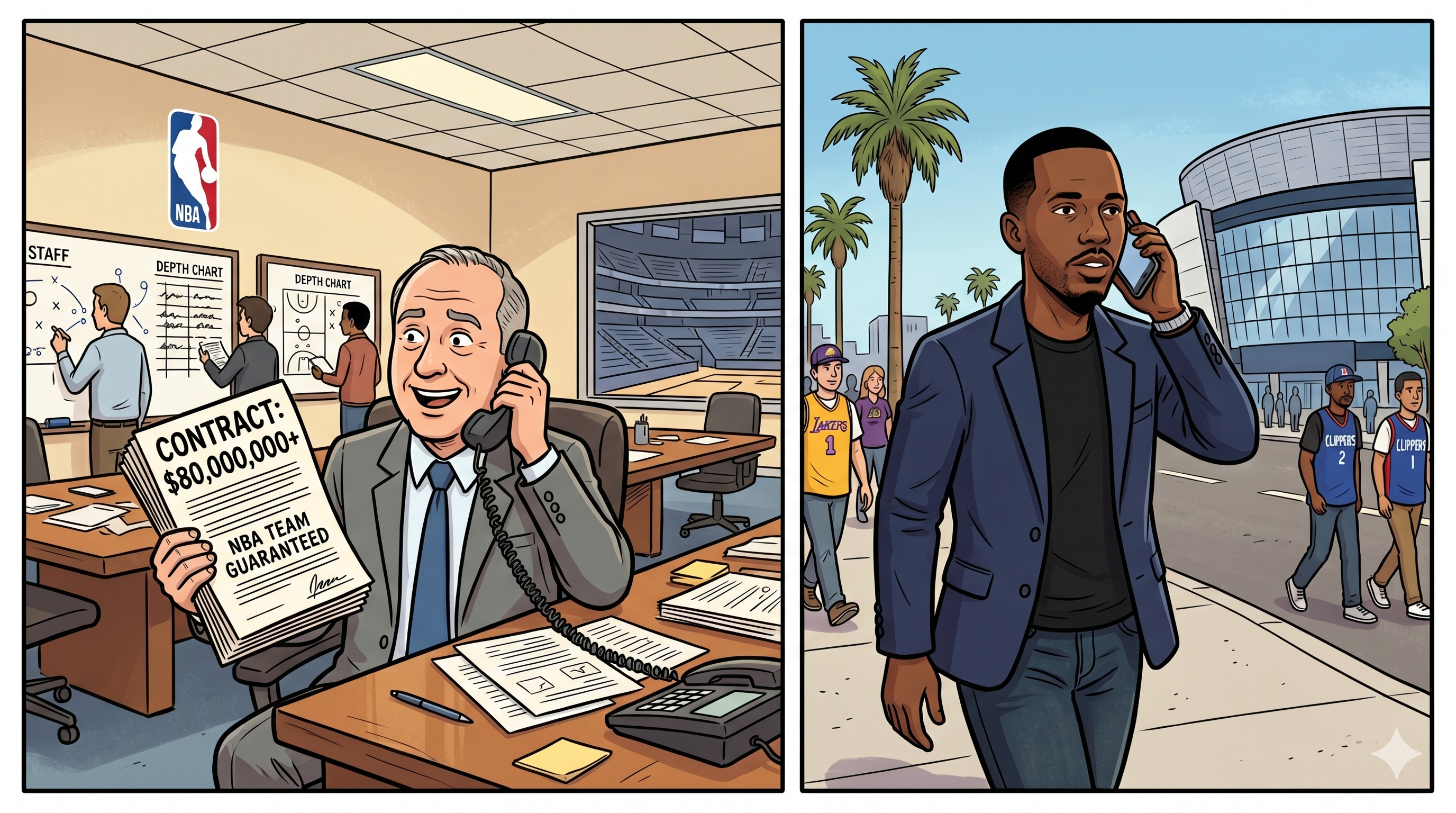
Peyton Watson is 23 years old, stands 6’8″ with elite athleticism, and just showed the NBA what he is capable of when given expanded responsibilities. In a 15-game stretch in January while Nikola Jokić was sidelined with a knee injury, Watson averaged 21.9 points per game and shot 46.2 percent from three-point range. For context, that accuracy ranked among the best stretches any wing in the league produced all season. Watson’s emergence as a top restricted free agent this summer is the direct result of that audition.
The Denver Nuggets hold his Bird rights, meaning they can match any offer sheet. Watson is on a $4.4 million salary — far below his demonstrated market value — which makes him a prime target for teams with cap room looking to land a young, switchable wing who can score and defend in a system built around a superstar. The Brooklyn Nets, Los Angeles Lakers, and Chicago Bulls all have the financial flexibility to table an aggressive offer.
The question is what Watson is actually worth. His full-season numbers — 14.9 points per game and 41.7 percent from three — are impressive but come with caveats. He missed time with a hamstring strain and was unavailable for Denver’s first-round playoff loss to the Minnesota Timberwolves. That absence illustrated his importance to the team, but it also raised durability questions that will factor into contract negotiations.
Denver’s cap situation is complicated by Jokić’s supermax and significant commitments to Jamal Murray and Michael Porter Jr. The Nuggets can match an offer sheet using their Bird rights regardless of their tax position, but absorbing a $25–30 million annual commitment for Watson would push the franchise deep into luxury tax territory. General manager Calvin Booth will need to decide whether Watson’s ceiling justifies that financial pain — especially with an aging core that has one, maybe two title windows remaining.
Watson’s value proposition is clear: he is an ascending 23-year-old wing who can guard 1-through-4, knock down threes at a high clip, and play next to Jokić without needing the ball to be useful. That profile — two-way, scalable, positionally versatile — is exactly what every contender is hunting. A three-year offer sheet starting at $23 million annually would be difficult for Denver to match without making painful salary decisions elsewhere.
Bruce Brown Jr. and Tim Hardaway Jr. round out Denver’s notable free-agent class. Brown, who helped the team win the 2023 title and returned on a minimum deal, is shooting 38.1 percent from three this season and has earned another above-minimum contract. Hardaway has provided 15.2 points per game this season and should earn a modest raise from his current minimum deal.
| Player | 2025-26 Salary | Rights | Projected Market |
|---|---|---|---|
| Peyton Watson | $4.4M | Full (restricted) | $20–28M/yr |
| Bruce Brown Jr. | $3.1M | Non-Bird | ~$6–8M/yr |
| Tim Hardaway Jr. | $3.6M | Non-Bird | ~$6–8M/yr |
Denver must match whatever offer sheet Watson receives, full stop. A 23-year-old wing who shoots 46 percent from three and plays elite perimeter defense is not a piece the Nuggets can afford to replace through the draft or the mid-level exception. Absorb the luxury tax hit, match the offer, and keep the most important young player on the roster intact for Jokić’s final championship window.
Leave a Reply