
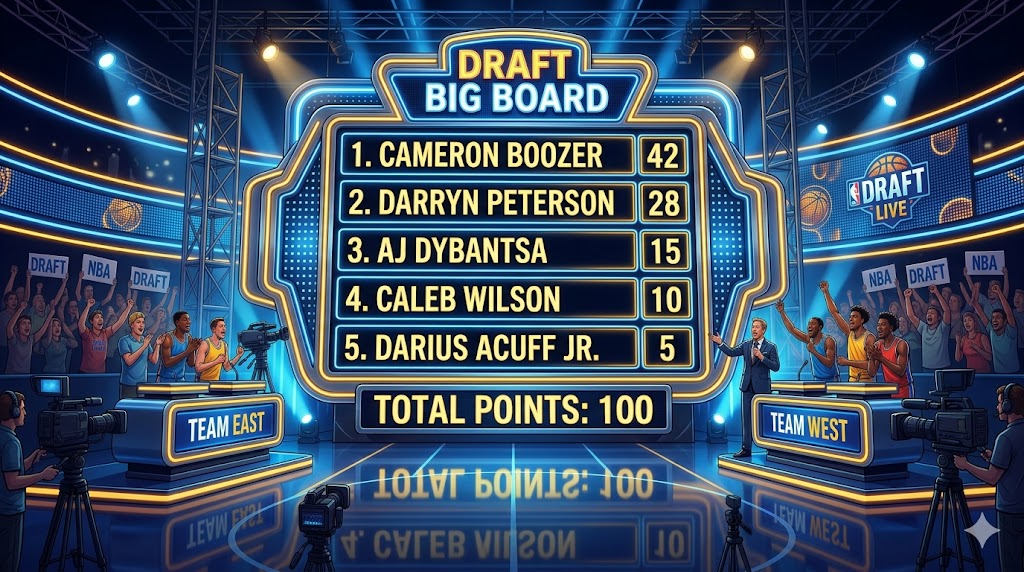
Utah’s front office spent months working angles to move up and potentially land AJ Dybantsa — the prospect who trained at Utah Prep and played his college ball at BYU, an institution with deep ties to Jazz ownership — but Bleacher Report’s Zach Buckley projects the Jazz to stay at No. 2 and select Kansas guard Darryn Peterson instead.
Utah holds only its own No. 2 overall pick in this draft. The Jazz have shipped out several future picks through multiple trade deadline deals, but the No. 2 spot alone gives this front office enormous leverage — and enormous opportunity.
Peterson is a case study in prospect evaluation complexity. His freshman season at Kansas was, by his own exceptional standards, uneven. He missed 11 of 35 games due to cramping issues he attributed to creatine use, and his efficiency dipped in the stretches he did play. But the underlying skillset is difficult to dispute. He stands 6-foot-6 with a 6-foot-10 wingspan, shoots the pull-up with the kind of fluid body control that makes defenders irrelevant, and plays with a defensive intensity uncommon for lead-guard prospects. Multiple scouts have drawn comparisons to Kobe Bryant in terms of his shot-making DNA and Klay Thompson in terms of his off-ball scoring ability.
The roster fit argument for Peterson in Utah is compelling. The Jazz have Keyonte George, a natural lead guard who has shown real ascent as a creator and pick-and-roll operator. What Utah lacks is a player who can generate offense without the ball — someone who thrives in movement actions, trails in transition, and operates as a pull-up threat in catch-and-shoot scenarios. Peterson profiles precisely as that player. His 6-foot-10 wingspan also makes him a genuine defensive asset beside George, someone who can switch pick-and-rolls and contest from elevation.
The opportunity cost at No. 2 is significant. Cameron Boozer, the Duke forward who goes third in this projection, is the most polished prospect in the class. A 6-foot-9, 253-pound forward who can post, face up, pass, and shoot 40 percent from three on volume, Boozer would give Utah the positional versatility to operate across multiple lineup configurations. Caleb Wilson, who goes fourth, is arguably the most physically gifted player in the class — 6-foot-10 with a 7-foot wingspan, rare mobility, and the defensive upside of a perennial All-Defensive candidate. Passing on either represents a real trade-off.
The outlet consensus around Utah’s direction is mixed, but most major forecasters agree Peterson is the most likely outcome. CBS Sports’ Adam Finkelstein has Peterson going second, as does Tankathon. Yahoo Sports’ Kevin O’Connor also has Peterson landing at No. 2. CBS Sports’ Cameron Salerno differs — projecting Dybantsa to land in Utah if a trade with Washington materializes, which reflects the genuine possibility of movement at the top of the draft.
| Outlet | Projected Player |
|---|---|
| Bleacher Report | Darryn Peterson |
| CBS Sports | Darryn Peterson |
| Tankathon | Darryn Peterson |
| Yahoo Sports | Darryn Peterson |
The Jazz added veterans Ace Bailey and Dylan Harper in last year’s draft, giving them two young playmakers at the lead guard level with legitimate star potential. Peterson doesn’t necessarily need to command possessions immediately — and that matters. Much like Bailey was eased into his rookie role in 2025-26, Peterson could develop within a structure already designed to protect young players from being overexposed.
Utah also has the franchise’s long-term architecture to consider. Owner Ryan Smith’s vision for the Jazz has always leaned toward organic development over free agent chasing, and adding a talent like Peterson — who, on his best nights, showed flashes of a 30-point scorer with elite two-way capability — aligns with that philosophy. The uncertainty around his health history is real, but at No. 2, Peterson’s ceiling justifies the investment.
Taking Peterson gives Utah a backcourt pairing of real substance. George’s facilitation and Peterson’s shot-making would form one of the more difficult guard combinations to gameplan against in the Western Conference within two to three seasons. That’s the kind of runway that makes Utah’s patience through the lottery era feel like it’s about to pay off in full.
Leave a Reply