
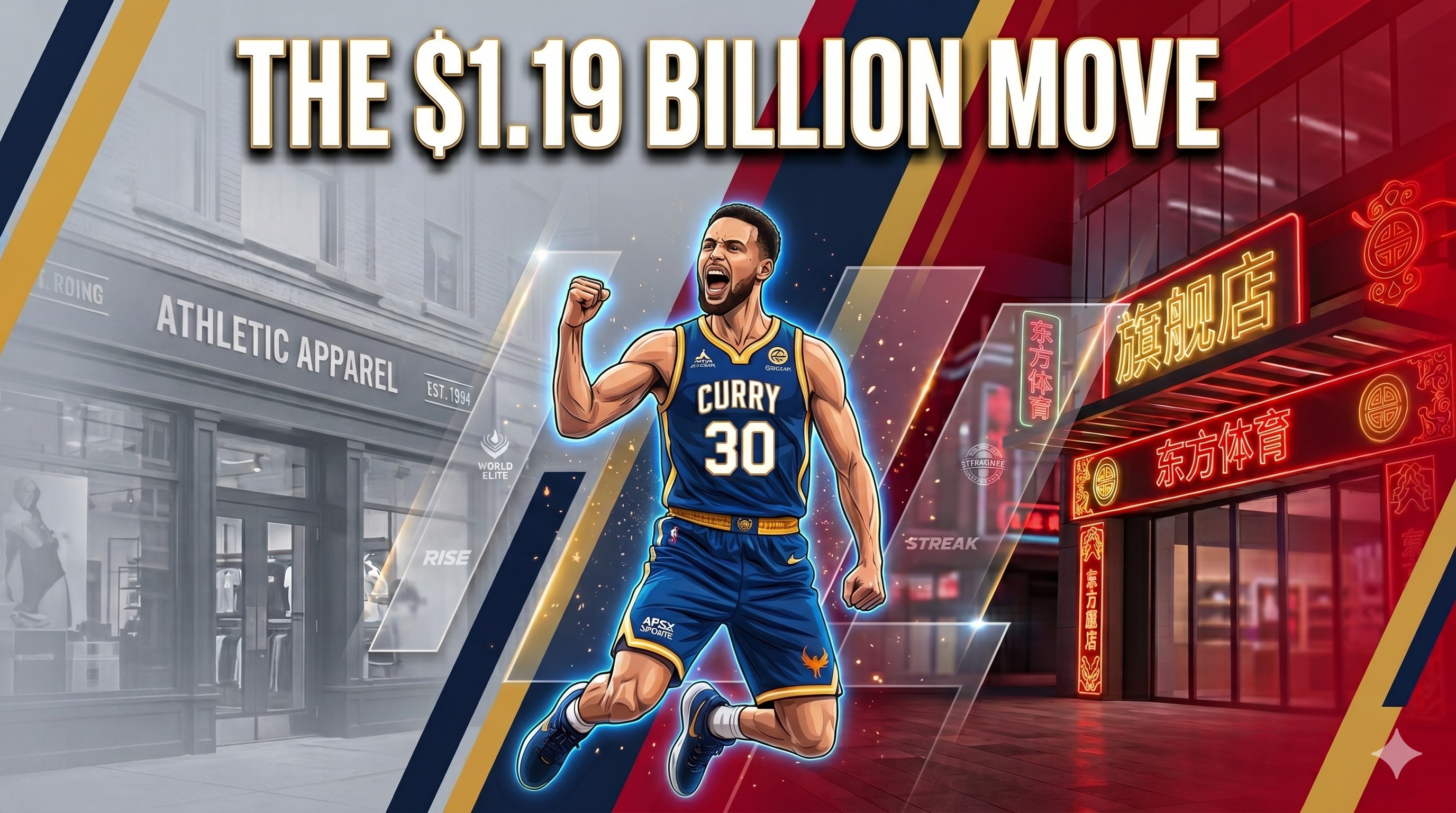
The brand that staked its entire identity on one man just watched him walk to China — and keep his name on the way out the door.
When Stephen Curry signed with Under Armour in 2013, it was one of the most undervalued deals in sneaker history. Nike had let his contract lapse — famously botching a pitch meeting where an executive reportedly mispronounced his name as “Stephon” and presented slides still branded for Kevin Durant. Under Armour swooped in for a reported $4 million a year. Within two seasons, Curry had won back-to-back MVPs, led the Golden State Warriors to a dynasty, and become the most transformative figure in basketball. For a brief, electric moment, it looked like the challenger brand from Baltimore had cracked the code.
It didn’t last. On November 13, 2025, Curry and Under Armour announced they were mutually parting ways after roughly twelve years together. Curry spent the following months as a sneaker free agent — reportedly lacing up a rotating cast of different shoes almost nightly — before ending the suspense this week. He signed a reported ten-year deal with the Chinese sportswear giant Li-Ning, the company founded by Olympic gymnast Li Ning. ESPN’s Shams Charania described it as a “landmark” agreement, and it’s been reported as worth an estimated $1.19 billion, spanning basketball, athleisure, and a full golf line, with Curry able to sign other athletes under his own label.
That last detail is the one Under Armour will be thinking about for a long time. Because Curry didn’t just leave — he took Curry Brand with him.
Under Armour’s Curry Problem Was Always Structural
Let’s be clear about what Under Armour got right: the first act. They signed Curry when no one else wanted him, gave him a signature line, creative latitude, and a genuine partnership. The “Charged by Belief” campaign was inspired. The shoes moved units. In 2020 they even spun up Curry Brand as a standalone label, the kind of gesture that signals a company is building something permanent.
But the Curry line was never embedded in a broader cultural ecosystem the way Jordan Brand is, or the way Nike’s portfolio creates a self-reinforcing universe. Jordan Brand has heritage, mythology, and deep streetwear and hip-hop entanglement that make it feel like more than footwear. Nike has LeBron, but it also has Kobe’s legacy, Kyrie’s cult following, and tentpole silhouettes like the Air Force 1 and the Dunk that keep the brand relevant even when any single athlete stumbles.
Under Armour had Curry. Full stop.
When his on-court dominance ebbed — through injury, age, and the Warriors’ roster churn — the Curry line lost its urgency. Sneaker culture runs on heat, on storytelling, on the collision of on-court greatness and off-court cool. Under Armour never cracked that second part. The Curry line was respected by hoopers but never became a streetwear staple. It never had a Panda Dunk moment, never crossed into the fashion ecosystem the way even a mid-tier Nike release can.
The brand compounded this with business decisions that signaled internal dysfunction: leadership turnover, disappointing earnings, an ill-fated push upmarket, and a product line that lost its direction. By the time the post-pandemic sneaker market normalized, Under Armour had no cultural cushion to fall back on. And critically, when the divorce came, Curry kept the rights to the brand that carried his name. Under Armour didn’t just lose the athlete — it lost the asset it spent years building, which walked across the ocean intact.
Enter Li-Ning: The Chinese Sneaker Insurgency Is Real
Here’s where the story gets genuinely interesting, and where American sports media has been slow to pay attention.
Li-Ning is not a niche brand. It’s a multibillion-dollar company that has spent more than a decade executing one of the more sophisticated athlete strategies in global sports. Its template was Dwyane Wade. In 2012 Wade left Jordan Brand for Li-Ning in a deal that gave him his own “Way of Wade” line — a partnership reportedly paying him around $8 million a year that, by some accounts, ballooned in value as the brand grew. “Way of Wade” became a genuine collector’s item with real cultural cachet, the proof of concept that an NBA star could build a lasting, lucrative brand outside the American giants.
The pattern with Curry is the same idea, scaled up enormously. Li-Ning is offering something American brands have struggled to match: brand ownership and co-creation authority, plus massive exposure in a market of 1.4 billion people, a huge share of them basketball-obsessed. The reported plan to open Curry Brand stores in both the U.S. and China reflects an ambition that isn’t merely “endorse our shoes” but “let’s build your company together.”
The financial logic for the player is simple. A fading signature line at an American brand still generates royalties, but the attention and investment behind it shrink. A partnership with Li-Ning offers a fresh start, a company that will build around you, and a market where your gear still sells by the millions. Wade’s experience showed it could work. Curry’s reported $1.19 billion shows how far the model has come.
The Counterpoint: The Biggest Stars Are Still Staying Home
It would be easy to spin this as a one-way migration, but the evidence is more nuanced — and that nuance matters.
The very top tier of the sneaker world hasn’t budged. Kevin Durant, far from leaving for a Chinese brand, signed a lifetime deal with Nike in 2023, becoming just the third NBA player ever to receive one, joining Michael Jordan and LeBron James. Durant has called that deal as meaningful to him as winning a championship and is routinely held up as a model of brand loyalty. LeBron’s own Nike lifetime deal is reported to exceed $1 billion. For the rarest class of culturally dominant superstars, the American machine — and the money and mythology behind it — still wins.
So the real story isn’t that everyone is fleeing. It’s that the next tier down is increasingly in play. Accomplished, decorated stars who are past their peak of domestic cultural dominance — exactly the profile Curry now fits at 37 — are precisely the players for whom the Chinese offer becomes irresistible. They get ownership instead of endorsement, a guaranteed market instead of a shrinking one, and a second act for their brand rather than a slow fade.
What This Means for Under Armour Specifically
Under Armour is in a genuinely precarious position. The company has been chasing a turnaround for years — cutting SKUs, refocusing on performance, hunting for an identity in a market that increasingly rewards either premium lifestyle (Nike, New Balance, On) or value-driven dominance.
Losing Curry isn’t just a marketing blow; it’s an identity crisis. The company’s basketball strategy was Curry. There’s no bench, no successor signature line waiting in the wings. For a brand that spent a decade telling the story of the underdog who wins — which was always, at its core, Curry’s story — losing him is like a film franchise losing its lead actor after building an entire universe around them. Joel Embiid, another marquee name Under Armour had courted, ended up reportedly aligning with Skechers, of all brands, as that company makes its own surprising push into basketball. The talent kept finding the exits.
What Under Armour lacks, fundamentally, is the cultural infrastructure that protects brands when athletes leave. Jordan Brand doesn’t die when a player retires because the brand is the athlete in a permanent, mythological sense. Nike’s lines survive departures because the brand has so many other pillars. Under Armour built a cathedral, and the whole thing turned out to be load-bearing on one column — a column that just relocated to Beijing and took its own name with it.
The Broader Trend: American Brands Are Losing Their Grip on the Middle
Zoom out and the picture sharpens.
For decades the assumption was simple: Nike and Adidas are the pinnacle, and you don’t leave them. That assumption is now being stress-tested in ways the industry hasn’t seen since the sneaker wars of the 1990s. Chinese brands aren’t just offering money; they’re offering structure, ownership, and access to a market where the NBA and its stars remain aspirational status symbols in a way that has cooled in the U.S.
Meanwhile, American brands are managing their own turbulence. Adidas absorbed the costly fallout of its split with Ye, which gutted its Yeezy-dependent revenue. Nike has navigated questions about brand relevance as the Dunk and Jordan 1 resale frenzy cooled. New Balance, improbably, became cool. Into that churn, Li-Ning, ANTA, Peak, and others are moving with purpose — not by poaching the LeBrons and Durants, but by capturing the deep, valuable middle of accomplished stars the American brands take for granted.
What Comes Next
None of this means Nike and Adidas are finished. Nike still dominates global sports apparel by a margin that won’t close soon, and the lifetime deals locking up Durant and James prove the top of the market remains firmly American.
But for everyone below that summit — the decorated veteran extending their legacy, the star who wants equity rather than an endorsement check, the player eyeing a global rather than purely American footprint — the Chinese brands are making an offer that’s getting harder to refuse. Curry’s $1.19 billion, ten-year, brand-ownership deal isn’t an outlier. It’s a signpost.
And sitting in Baltimore, the people running Under Armour should be asking a very uncomfortable question: if not Curry, then who? And if not basketball built around one transcendent star, then what?
Because the brands that win the next era of this business won’t be built on one player and a prayer. They’ll be built on systems, on culture, and on ownership structures that turn athletes into partners rather than billboards.
Under Armour built the billboard. Curry owned the wall — and he just took it with him.
Related: Some stars are rewriting the athlete-brand relationship entirely — here’s why Wembanyama’s opposition to energy drinks is bolder than Tom Brady or Cristiano Ronaldo’s.
Leave a Reply